GMR eyes expanded Philippine presence as new Indian Airport opens

Indian infrastructure giant GMR Group is looking to further expand its footprint in the Philippines following the inauguration of the Alluri Sitarama Raju International Airport, also known as Vizag Airport, in Bhogapuram, Andhra Pradesh, India.
The new airport is being positioned as a potential gateway connecting India with Southeast Asia, including the Philippines, opening opportunities for stronger trade, tourism, logistics and air connectivity between the two regions.
Indian Prime Minister Narendra Modi led the inauguration ceremony, joined by Andhra Pradesh Chief Minister Nara Chandrababu Naidu and Civil Aviation Minister Kinjarapu Ram Mohan Naidu. In his remarks, Modi emphasized that investment, production, exports and employment are key drivers of economic prosperity.
Developed through a public-private partnership at a cost of more than $587 million, Vizag Airport is scheduled to begin full commercial operations on August 17. It will initially accommodate up to six million passengers annually, with plans to expand capacity to more than 40 million passengers.
Located along India’s eastern coast, the airport is expected to strengthen connections with ASEAN countries, including the Philippines, potentially paving the way for more direct commercial flights between India and the country.
The development also complements GMR’s long-term aviation strategy in the Philippines. The company has established a strong presence in the country through its involvement in the transformation of Mactan-Cebu International Airport and the development of the modern passenger terminal at Clark International Airport.
GMR has also partnered with Philippine firms Cavitex Holdings Inc. and House of Investments for the proposed development of Sangley Point International Airport and Sangley Aerocity in Cavite. The project aims to help address congestion at Ninoy Aquino International Airport while creating a major new aviation and economic hub.
GMR Group Chairman for Energy and International Airports Srinivas Bommidala said the company remains open to pursuing additional opportunities in the Philippines, including Sangley and other regional airports.
“We’ll be more than happy, because we have already done two projects in the Philippines in recent years,” Bommidala said, adding that GMR is willing to explore projects that could benefit both India and the Philippines amid increasing government-to-government engagement.
The push comes as relations between Manila and New Delhi continue to deepen, with bilateral trade and government cooperation gaining momentum. During President Ferdinand Marcos Jr.’s visit to India last year, GMR executives discussed the potential development of Sangley Point International Airport and Sangley Aerocity, as well as opportunities involving other regional airports.
Interior Secretary Jonvic Remulla earlier said Marcos had instructed relevant government agencies—including the Departments of Transportation, Finance and Trade and Industry, as well as the Philippine Navy—to facilitate GMR’s investments in the country.
The Sangley Point and Aerocity development is projected to generate as many as 15,000 direct and indirect jobs and contribute millions of dollars in government revenues.
Bommidala described the inauguration of Vizag Airport as another milestone in GMR Airports’ global expansion, with operations spanning India, Indonesia, the Philippines and Greece.
He said the company is building an integrated international aviation platform designed to connect economies, boost tourism, facilitate trade and create opportunities for local communities.
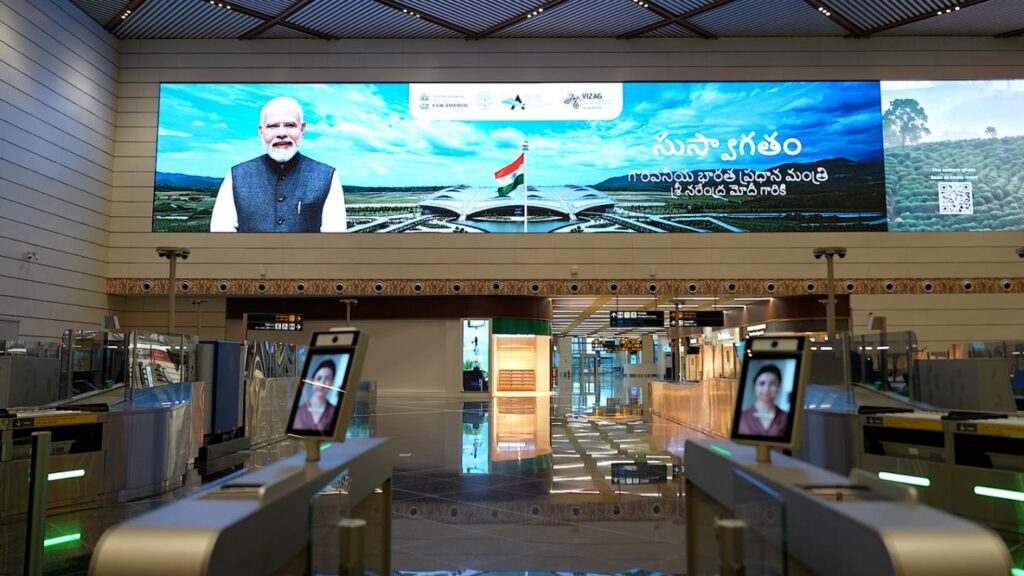
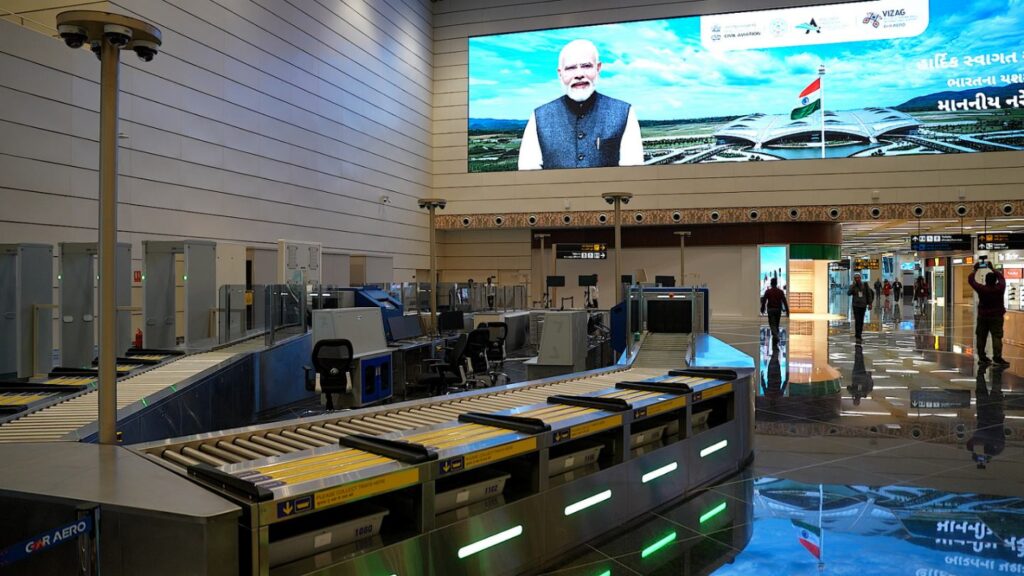
Named after Indian revolutionary and freedom fighter Alluri Sitarama Raju, the new airport features a next-generation passenger terminal inspired by the locally found flying fish known as “Parava meenu.”
The terminal is equipped with self-service facilities, e-gates and advanced baggage-handling systems. It is also designed to withstand severe weather conditions, including wind speeds of up to 275 kilometers per hour, while the air traffic control tower can withstand winds of up to 295 kph.
Technology is central to the airport’s operations, with smart airport systems, DigiYatra facial-recognition technology, AI-enabled passenger services and an Airport Predictive Operations Center providing real-time monitoring and predictive analytics.
Its airside facilities include a 3,800-meter Code 4E runway, parallel taxiway, rapid-exit taxiways and 18 aircraft stands, supported by a 55-meter ATC tower.
Sustainability features include energy-efficient systems, green building standards, natural lighting and a 5-megawatt solar power plant.
Beyond the airport itself, the development includes a 154-acre Aerocity, a residential township and an industrial zone intended to create an integrated ecosystem for business, logistics, training and aerospace-related industries.
With Vizag Airport now set to become a major aviation hub on India’s eastern coast, GMR’s expanding presence in the Philippines could further strengthen the air and economic links between India and Southeast Asia.

- Tiangco: SC ruling, nagpapatibay sa panawagan para sa transparency sa national budget - October 21, 2026
- “𝗘𝘅𝗰𝗶𝘁𝗲𝗱 𝗻𝗮 𝗮𝗸𝗼𝗻𝗴 𝗶-𝗲𝘅𝗲𝗰𝘂𝘁𝗲”: 𝗕𝗿𝗶𝗹𝗹𝗶𝗮𝗻𝘁 𝗦𝗸𝗶𝗻 𝗖𝗘𝗢 𝗚𝗹𝗲𝗻𝗱𝗮 𝗗𝗲𝗹𝗮 𝗖𝗿𝘂𝘇, 𝗱𝗮𝗹𝗮 𝗮𝗻𝗴 𝗛𝗮𝗿𝘃𝗮𝗿𝗱 𝗹𝗲𝗮𝗿𝗻𝗶𝗻𝗴𝘀 - October 5, 2026
- Senate Resolution No. 591: Aquino, kinilala ang limang Pinoy dance crews sa world competition - September 9, 2026